How does a Mutual Funds SIP work ?

A SIP is a specific amount, invested for a continuous period at regular intervals, generally on a monthly basis. Using this method, an investor buys units of a scheme at a pre-decided frequency.

Consider the below: (Example taken for illustration purpose only)

You decide to start a monthly investment of Rs 1000 every month for the next 12 months starting from Jan 2018.

Now let’s say you invest in Fund XYZ, whose current Net Asset Value (price per unit of the fund) is 10 Rs. So in the first month, you end up buying 100 units of the fund. (Rs 1000/Rs 10 per unit).

Now in the month of February, the fund Net Asset Value goes up to 10.2 Rs. So for your monthly investment in Feb of Rs 1000, this time you get 98.04 units (Rs 1000/Rs 10.2 per unit).

Similarly you can go on like this till December. Now let’s say on 31st December you have accumulated a total of 1123 units, and the fund net asset value is increased from Rs 10 in Jan to Rs 11.4 in December.

Your total investment: 1000*12= Rs 12000

Your current investment value= 1123*11.4= Rs 12800

Profit= Rs 800

A SIP basically helps you to average out your buying price throughout the year, so that ups and down in the market do not affect you. The longer you remain invested in your SIP, the more you units you can accumulate and the more your fund value grows.

In case you need personalised investment advise on which particular funds to choose, you can drop an email or whatsApp to me
https://bit.ly/Pramada-Advisory

Personal Finance Plan

First step towards a successful personal finance plan is creating an Budget.

Budgeting requires that you analyze and, likely change your spending habits. Instead of your money controlling your habits, you control your money.

A successful budget clearly outlines:

• A Monthly spending plan
• Ways for reducing your monthly bills
• How to handle accrued debt
• How to distinguish between short-term, medium and long-term goals
• A breakdown of family needs
• Source of monthly revenue

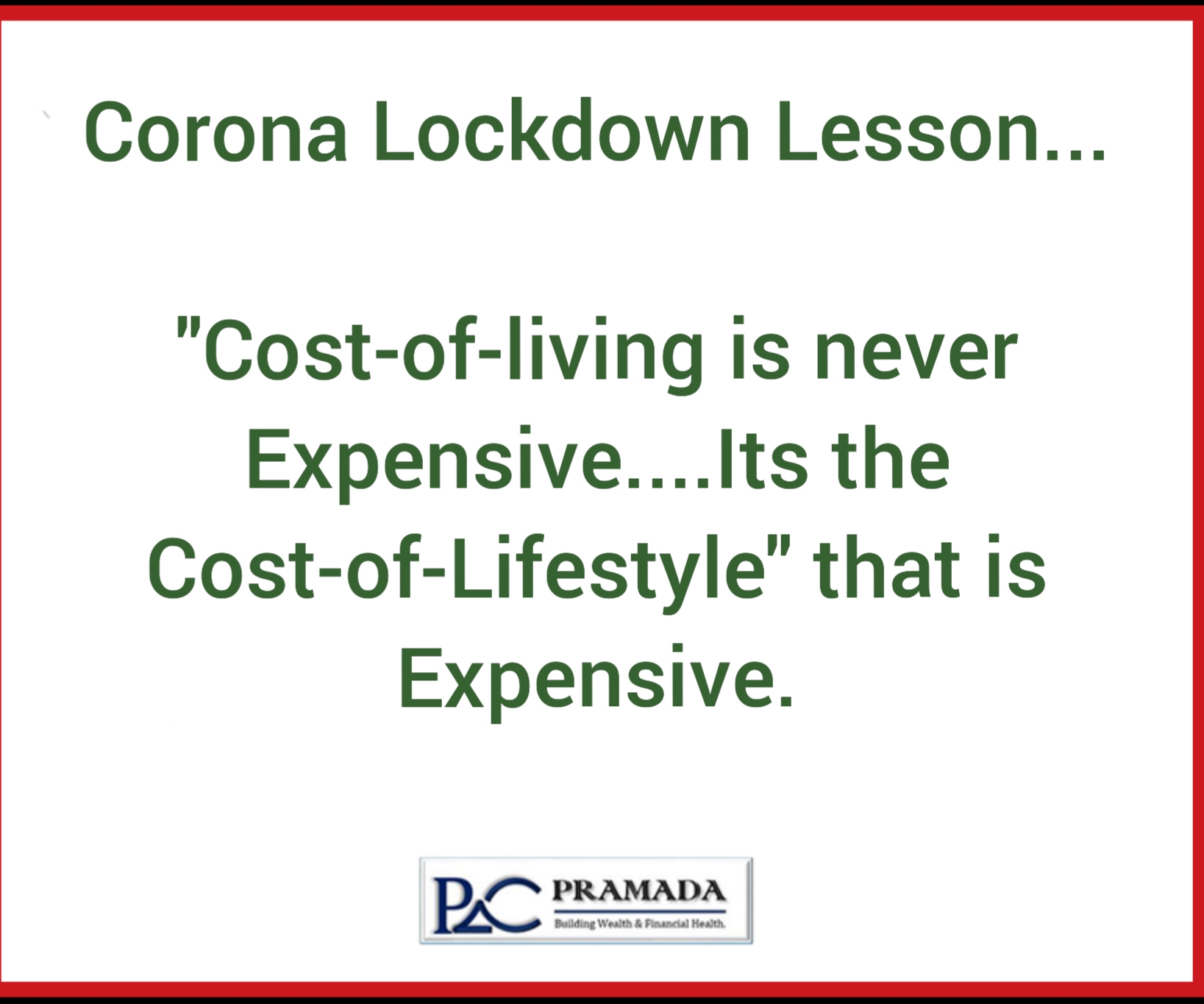
It is not as difficult as it seems. This lock-down has taught everyone that The Cost of Living is NOT Expensive but the Cost of Lifestyle is what is Expensive.

https://bit.ly/Pramada-Advisory

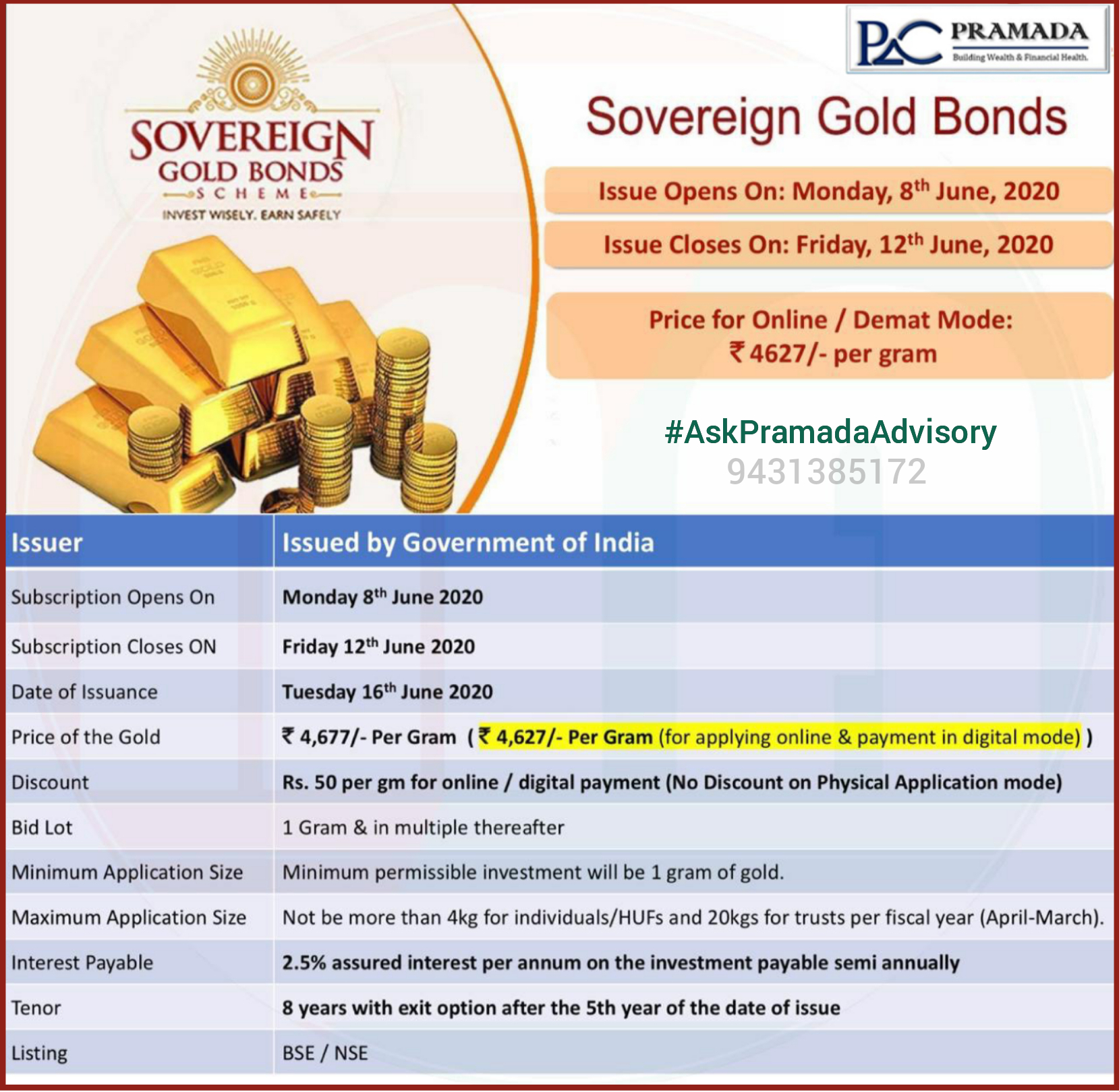
Sovereign Gold Bond 2020-21 – Series III

Why invest in Sovereign Gold Bonds?

❖ Safest way to buy and store gold
❖ Earn 2.5% assured interest per annum on the investment payable semi annually
❖ Asset appreciation opportunity plus assured interest
❖ Issued by Government of India.
❖ Tradeable on Stock Exchange
❖ No TDS applicable
❖ Can be used as collateral for Loans*
❖ The bonds will be available both in demat and paper form.
❖ Indexation benefit if bond is transferred before maturity
❖ No Capital Gains Tax on redemption

रिटायरमेंट प्लान (Retirement Plan)

आज इंडिया में ऐसा कोई रिटायरमेंट प्लान उपलब्ध नहीं है, जहा पर आप अपने वर्किंग पीरियड के दौरान इन्वेस्टमेंट करके आपके रिटायरमेंट के दौरान हर माह निश्चित रकम पा सके |

इसके लिए आपको आपकी इनकम शुरू होने के साथ ही उसका प्लानिंग शुरू करना जरूरी है| इसकी जरुरत क्यों है, ये आपको निचे बताई गई कुछ बातो से पता चलेगा,

1.. पहले बैंक ऍफ़.डी का इंटरेस्ट रेट करीब 13% था, पोस्ट के सर्टिफिकेट में करीब 14%, पी.पी.ऍफ़. में करीब 12% था जबकि इन्फ्लेशन करीब 10% रहता था तो नेट इंटरेस्ट पॉजिटिव मिलता था |

  1. आज से 15 – 20 साल पहले ज्यादातर लोग सरकारी नौकरी करते थे और वो जब रिटायर होते थे उसके बाद उनको पेंशन मिलता था जो की इन्फ्लेशन के साथ बढ़ता था |

३. आज से 15 – 20 साल पहले से हमारा खर्चा लाइफस्टाइल में ज्यादा बढ़ा है, जिसके कारन हम इन्फ्लेशन कम रहने के बावजूद कई बार तंग अवस्था पैदा करते है |

अगर आज कोई फॅमिली का मंथली एक्सपेंस 25000 रूपये है, तो आज से २५ साल बाद यही खर्चा अगर ६% इन्फ्लेशन को भी ध्यान में ले तो वो करीब 112000 रूपये हो सकता है,

क्या आपको लगता है 25 साल बाद आपके इन्वेस्टमेंट पे आपको 6% इंटरस्ट मिलेगा? बिलकुल नहीं शायद ज्यादा से ज्यादा 2% से 2.50% मिल सकता है और अगर यही हुआ तो आपको हर महीने रिटायरमेंट के बाद के इन्फ्लेशन को ध्यान में न ले फिरभी 112000 रूपये के खर्च के लिए आपको 56,00,000 की वेल्थ आपके पास होनी चाहिए, और अगर आप इन्फ्लेशन को ध्यान में ले तो ये शायद 75,00,000 हो जायेगा |

यही 75,00,000 लाख की वेल्थ बनाने के लिए अगर आजसे आप 8% की इंटरेस्ट में इन्वेस्ट करते हो तो आप हर महीने 8250/- का इन्वेस्टमेंट करना पड़ेगा, मगर यही इन्वेस्टमेंट अगर आप 5 साल बाद शुरू करोगे तो आपको हर महीने 13200/- का और अगर 10 साल बाद शुरू करोगे तो आपको हर महीने 22200/- का इन्वेस्टमेंट करना पड़ेगा |

Understanding Arbitrage Fund…

Q.What is an arbitrage Fund ?

A. An arbitrage fund is one which uses equity market for debt like returns which gets tax benefit of an equity fund.

Q. Wow. How does it do this ?

A. It invests on an average 65%+ in cash future arbitrage, 20-25% in FDs for margin and 10% in Cash or Short Term Debt .

Q. What is cash future arbitrage?

A. The word arbitrage means taking advantage of price difference between 2 markets. Cash future arbitrage is one where you buy in Cash Market and Sell in Future’s Market.The difference is called arbitrage spread or your profit. You generally do it every month from one expiry to another expiry.

Q.This is very simple.Can we make lots of money ?

A. No.Since it is simple one cannot make lots of money as many people can & will do it. One can basically expect to make a short term fixed income like returns with better tax efficiency.

Q.So is it fair to say an Arbitrage Fund is in the nature of fixed income investment?

A.Yes for simplicity sake one can say that. It is also true if one really understands the nature of transaction cash-future trade is.By doing this trade you are providing funds, to somone who wants to take a long position in a stock in Futures Market , against the security of the same stock that you hold and earning the spread which is nothing but your interest on your capital deployed in cash market.

Q.I have captured the spread at the start of the cycle but can i loose money when i am trying to square off the cash future transaction?

A.The price in cash and futures market will converge on the date of expiry. Hence you are protected from market volatility. Once you have captured the spread you dont have to worry. At the end of expiry of the futures contract you can settle it against physical delivery. Or you can roll over the same for another month or you can square off both cash & future trade.So there are many options.

Q.Can returns be volatile? If yes what is the ideal investment horizon?

A.During the same cycle of one expiry to another expiry returns can be volatile as markets may move in all kinds of directions. But at the end of expiry both prices will converge and give you your pre assessed return.

Keeping the above in mind it is advisable to invest with a minimum of 3 months horizon or more. After 12 months it become even more tax efficient as LTCG sets in.

Q.What do i need to watch out for when i invest in any arbitrage fund?

A. You should look out for the following -Whether the fund is 100% hedged or not & Quality of fixed income exposure. Check for credit as well as duration risk.

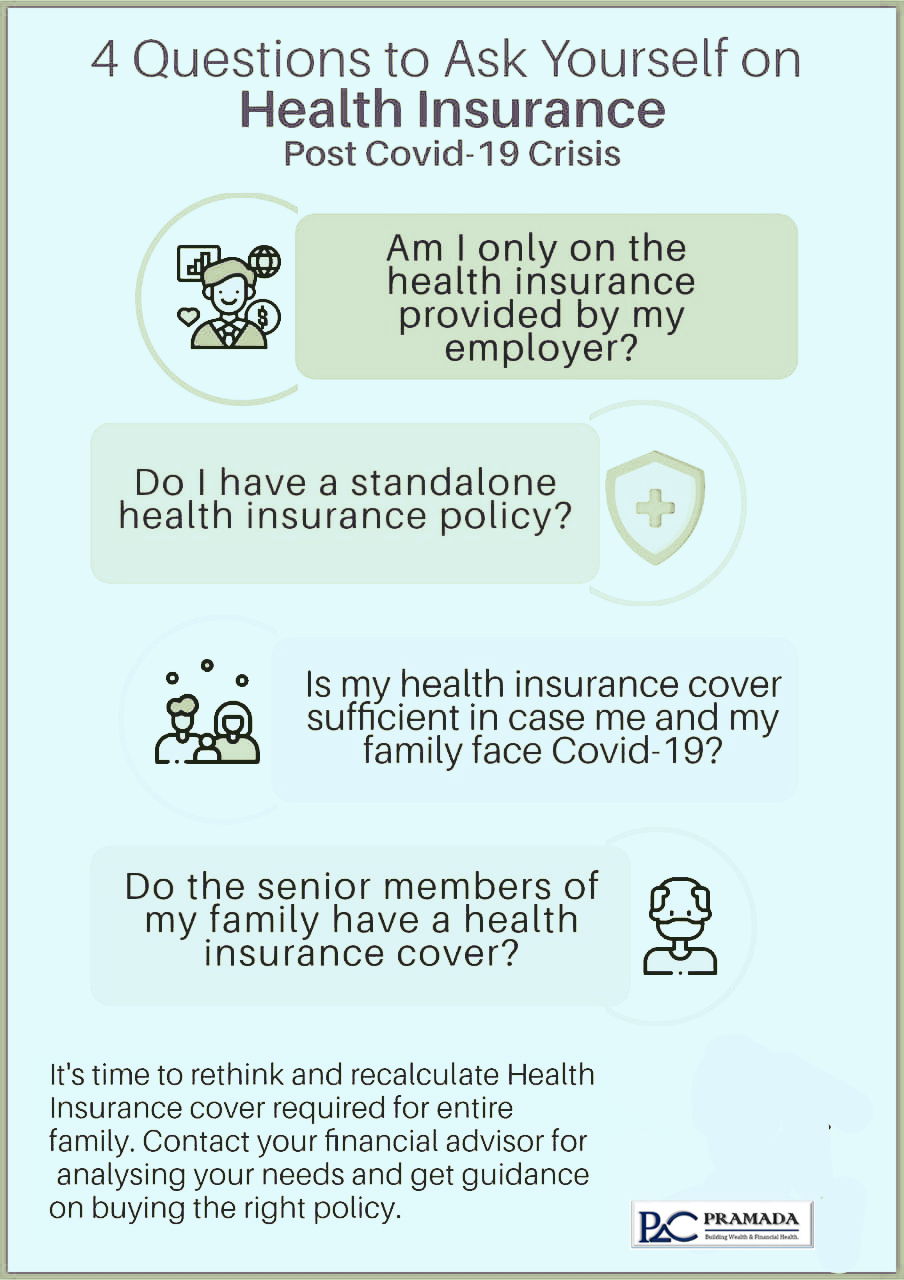
4 Question to Ask Yourself on Health Insurance post Covid-19 Crisis


📌 Am I only on the health insurance provided by my employer?


📌 Do I have a standalone Health insurance policy?


📌 Is my health insurance cover sufficient in case me and my family face Covid-19?


📌 Do the senior members of my family have a Health insurance cover?


It’s time to rethink and recalculate Health Insurance cover required for entire family.

Contact your financial advisor for analysing your needs and get guidance
on buying the right policy.

EMI Moratorium….

The EMI moratorium, initially allowed from March to May, has now been extended to August. Banks and NBFCs can allow you, at their discretion, to avail of the moratorium on your loan. If you are facing difficulties due to the lockdown, for instance, loss of job or pay cut or general uncertainty, you would be tempted to avail of the moratorium. However, you have to be aware of the catch. For the period you avail of the moratorium, there is no interest waiver.

That means, the three or six EMIs which you are now deciding not to pay, you will have to pay later. Not only that, you will have to pay a hefty interest on this interest (for the three or six months) later on.

As an example, if you have taken a 10-year home loan and avail of three months’ moratorium, at the end of 10 years, you will have to pay three more EMIs. But the story does not end there. Interest will be compounded for a period of 10 years (or your remaining period) and the additional EMIs you will have to pay will be much more than three. This is due to the power of compounding; over a long period, the interest on the three or six months of EMI will be a hefty amount.

Net-net, in spite of the lockdown blues, if you are in a position to pay your EMIs, it is in your benefit. In case you are in dire straits, then the only implication of the moratorium for you is that you will not be called a defaulter.

“Kubler Ross Model”

The fear of the people when our country’s corona count was 100, is not there when it is over 1,50,000 today.

The answer lies in the psychological view of man. There is a philosophy called the “Kubler Ross Model”. That is, when a human goes through any tragedy, natural disaster, accident, they pass through 5 stages. They are
1.Denial
2.Anger
3.Bargain
4.Depression
5.Acceptance

  1. Denial – Refusal to believe such a thing ever happened. For example, we all denied that Corona will not come to us. Even if it comes, repeated denial that it will not spread to our place due to hot climatic conditions.
  2. Anger – Getting angry. For example, anger over the loss of income and the loss of normal life due to lockdown.
  3. Bargain – Inwardly lamenting that the Corona may not have come and there should not have been a lockdown at all.
  4. Depression – It happened like this and goes in to mental pressure and depression.
  5. Acceptance – the last stage. The other way around is to accept it. Example: Get used to live with Corona.

These 5 levels are not limited to Corona. Applies to all the problems in human life.
What will the wise person do ?
Going straight from the first level to the fifth level. He will set himself to make next steps to progress in life.

He who is trapped, in any stage, without reaching the fifth stage, becomes mentally ill.

Should I start an SIP or invest a Lumpsum ?

Should I start an SIP?
Ans : Absolutely

Any time is a good time for starting your SIP. You don’t have to wait for a downturn. If you do, you may have to wait for long, which may result in a lost opportunity. By their design, SIPs help you average your investment cost. So waiting for the right time to start them is pointless.

Should I invest a lump sum?
Answer: No

In equity, never invest lump sums as you won’t be able to benefit from market lows. In the current phase, if you invest a lump sum and the market falls further, you won’t be able to benefit from the fall. Hence, invest through SIPs. Spread your lump sum across six to 12 months, depending on its size.