Best ways to invest money…

No risks and sky-high returns are the two things that an investor looks for while thinking of investing their money. However, you must know that these two can’t co-exist. Wherever there would be high returns (stocks), there would be more risks of losing money.

Nevertheless, you can always analyze your risk-taking ability and get set to multiply your money.

Let’s see the investment options available.

The top investment options in India are divided into two categories:

1. Financial

These are market-linked and fixed income investments. For example, stocks, mutual funds, fixed deposits, public provident fund, etc.

2. Non-financial

These may include gold and real estate.

Here are the top investment options in India that can help you reach your financial goal.

  • Fixed Deposits

This is the most secure option. You can transfer some of your savings to a fixed deposit at a bank of your choice and enjoy monthly, quarterly, yearly, etc. interest on your deposit.

  • Stocks

The volatility of the market can both yield high returns on the money invested, as well as losses in case of predictions going wrong. However, if you keep the money invested for a while, and choose stocks of a good stability and quality, equity is usually able to deliver equivalent or even more returns in the future. However, you must refrain from investing in risky stocks at this time of the COVID-19 pandemic, considering how volatile the market is.

  • Senior Citizens Savings Scheme

If you’re above 60, this is the best scheme for you. It has a five-year tenure, with an upper limit of investment at a good Rs 15 lakhs. You get the interest on the amount every three months till the amount matures.

These are a few of the best investment schemes in India. Try them out. But ensure that you’ve consulted a financial expert.

In case you need personalised investment advise on which particular funds / schemes to choose, you can drop an email or whatsApp to me

https://bit.ly/Pramada-Advisory

What does 15×15×15 = 1 crore mean in mutual funds ?

“Compound interest is the eighth wonder of the world. He who understands it earns it and, he who doesn’t pay for it”- Albert Einstein.

With this quote, the renowned genius wanted to highlight the importance of the ‘power of compounding,’ which holds true in investing too.

That’s because, when you invest for the long term, the interest amount you earned on your invested money also starts earning interest, resulting in a huge corpus over the long term.

This 15*15*15 rule implies the same benefits of ‘power of compounding.’ It states that if an investor starts a SIP of Rs 15,000 per month at an assumed CAGR (compounded annualized growth rate) of 15% for 15 years, it can fetch you an amazing wealth of Rs 1 Crore upon maturity.

Apart from this, there is also one more 15*15*30 rule that you should be aware of

Rs. 15,000 SIP at an assumed CAGR of 15% for 30 years can give you return of Rs. 10 Crore upon maturity. By just increasing your tenure by 15 years, one can get ten times more return. The investment amount is Rs 54 lakhs, but the amount accumulated by then is Rs 10 Crore.

The moral of the story is that if you want to create wealth, you need to keep patience and stay invested for the long term.

“Wealth cannot be earned. It has to be created.

https://bit.ly/Pramada-Advisory

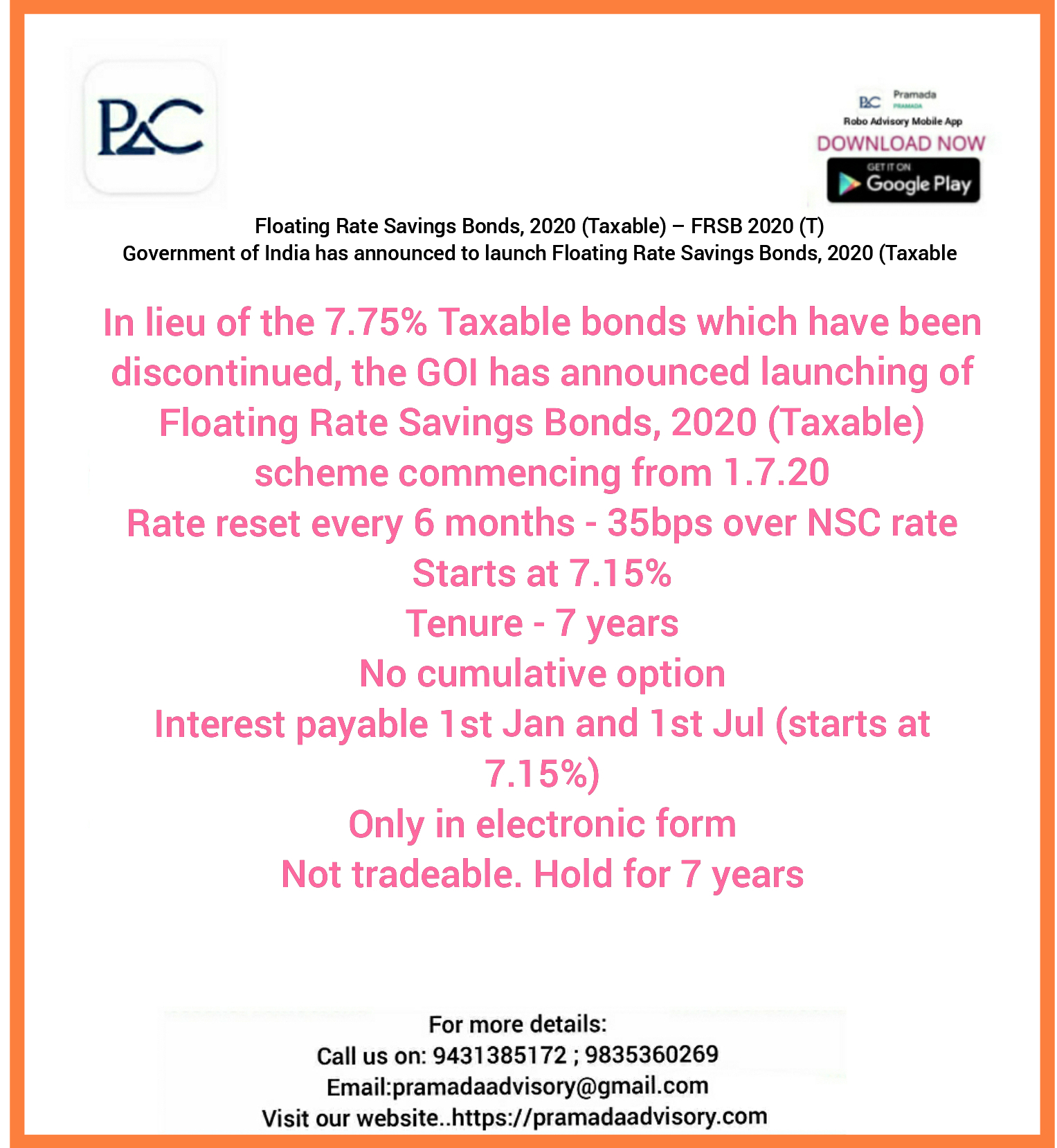
Floating Rate Savings Bonds, 2020 (Taxable) – FRSB 2020 (T)

After withdrawing the popular 7.75% (taxable) bonds on 28 May, the government has announced the launch of a new series of bonds with an interest rate of 7.15%. However, the rate will be reset every six months as per prevailing interest rates. The bonds will have a tenor of seven years and their interest will be taxed at your slab rate. They can be purchased from nationalized banks and specified private sector banks. Only resident Indians or Hindu Undivided Families (HUFs) can subscribe to the bonds.

The notes have a minimum subscription of ₹1,000 and you can subscribe in multiples of₹1,000. There is no maximum limit for investment in them. The interest rate on the bonds will be paid on 1 January and 1 July every year. The first interest rate payment will be made on 1 January 2021 at 7.15%. You can also reinvest the interest to buy fresh bonds in the multiples of₹1,000 to compound your money. However, these bonds will have a fresh tenor of seven years.

The bonds cannot be traded or used as collateral for loans. However, they can be inherited by the legal heirs of the holder. Premature redemption will be available for senior citizens in certain cases.

A floating rate can adjust higher when overall rates in the economy go up. This can help bondholders in times of high inflation when interest rates are generally hiked. However, when interest rates head lower, the rates on the bonds will also be reduced.

If you are a senior citizen, you can also invest in Pradhan Mantri Vaya Vandana Yojana (PMVVY) and Senior Citizens Savings Scheme (SCSS). Among these alternatives, only SSY, SCSS and PMVVY currently offer higher rates than the proposed bonds at 7.6% and 7.4% and 7.4%, respectively. However, SSY is only available for the parents of a girl child below the age of 10 and has a maximum deposit limit of ₹1.5 lakh per year. Similarly, SCSS and PMVVY have a maximum limit of ₹15 lakh per person and are only open to senior citizens.

In case you need personalised investment advise on which particular funds or schemes to choose, you can drop an email or whatsApp to me.

https://bit.ly/Pramada-Advisory

https://t.co/j0dZul5gaS

Which money you should keep in Liquid Mutual Funds ?

  1. Your salary till your next EMI due
  2. Bonus till you spend/plan it
  3. Sales proceeds of your flat till you invest in new one
  4. Funds created for your child’s education /marriage till you use it
  5. LumpSum amount lying in your bank account which you may be required any time
  6. A Funds lying ideal for long weekend

Why you should invest in liquid fund?

  1. No locking period (You can withdraw money at any time)
  2. Historically return 5% to 5.5% p.a as against 2.75% in saving account or 0% in current account.

In case you need personalised investment advise on which particular funds to choose, you can drop an email or whatsApp to me

https://bit.ly/Pramada-Advisory

Step up SIP

In a step-up Systematic Investment Plan (SIP), the SIP amount increases automatically at a predefined rate and period. It means you can increase fixed amount of SIP contribution per year at a prefixed percentage.

For example suppose you have Rs.10000 SIP in mutual fund and you decide to increase your SIP amount by 10% every year for next 10 years then your second year SIP amount would be Rs 11000. Your third year SIP amount would be Rs 12100 and so on.

Step up SIP helps investor to accumulate wealth with a smaller amount initially. As individual’s income increases he/she can increase the SIP contribution in that proportion. So the question may arise that should investor increase his/her SIP as the income increases?

Ideally, it should be. If you do so you can achieve your Financial Freedom early.

Let’s see it in the example.

One of my clients wanted to accumulate 6 Cr for his retirement. He was 29 years old. His monthly take home salary was 50000Rs.

I gave him two options….

I proposed him to make SIP in good quality Equity Mutual fund. SIP made in a good quality Large, Multi-cap funds and smaller portion in Mid and Small caps can generate returns ranging from 12 to 16% p.a. But considering ups and downs in equity market it is always prudent to be realistic and reasonable. SIP investments’ rate of return should be considered at 11% p.a.(overall portfolio return) for safer side for SIP investment.

Let’s study those two different scenarios which I had proposed to understand how he would accumulate his targeted amount of 6 CR.

Scenario 1:

Rate of return -11%

Tenure 25 years

Monthly Investment required to hit the target of 6 Cr is Rs 37750 throughout his tenure i.e. 25 years.

From 50000 rs salary he had to invest more than 70% of the salary to his single life goal, which is simply Impossible.

Scenario 2

Rate of return -11%

Tenure 25 years

Monthly Investment required to hit the target of 6 Cr is Rs 16100 only for the first year which comes around 32% of his salary.

As the client was young, single and no major responsibility on his shoulder he could manage this SIP amount easily.

I proposed him to have 10% annual increase in monthly SIP amount every year as per his salary hike. So 2nd-year monthly investment he made was Rs 17710 and on the 3rd-year monthly investment made was Rs.19481 and so on…

My client was very happy to know about Step Up SIP concept. He accepted the second proposal as he was sure 10% increase in his salary year-on-year.

To Summarize

  • In the 1st scenario, we assume a flat monthly SIP investment throughout the tenure to accumulate the targeted amount.
  • The 2nd scenario, we used Step up SIP where a fixed percentage of increase in monthly SIP per year done with an increase in income every year to accumulate the targeted amount

Gradual sustainable increase in saving per year with an increase in income will help my client to achieve his dream target.

So this a magic of Step Up SIP. I advise you all to go for this concept to fulfill all your life goals. It helps to achieve Financial Freedom early in life.

Happy investing !!!

https://bit.ly/Pramada-Advisory

Financial Tips for Middle Class People

  1. Don’t buy house with housing loan. Buy one with your own money. It may take time but at least you won’t make any financial loss or risk.
  2. Invest as early as possible because middle class people know the value of money and time.
  3. Spend to the extent of what you can sustain spending. Don’t spend because others living that way its only disturbs you not them.
  4. Have health cover for yourself and family. Take term insurance as well.
  5. Know the expenses and track them it helps you to minimize your expenses.
  6. Know the difference between need and want.
  7. Invest in yourself if you do this many obstacles will automatically turn backward.
  8. Live life with purpose and you will find way to success.
  9. Open bank account other than your salary account and start saving some money as it helps you in future. You won’t need to borrow money from anywhere as you have your own. Cash you’ll need in your life everywhere so value it.
  10. Income – savings = expenses This should be your formula of living rather than old one Income – expenses = savings.
  11. Learn new skills which will help you to built passive income.

Happy reading !!!

https://bit.ly/Pramada-Advisory

Savings Rule

There is a famous “100 minus your age” rule.

It says…

Spend the percentage equal to your age and Save/Invest the 100 minus your age percentage of your total income. Let’s say your age is 24. Then, spend 24% of your income in your expenses and save/invest (100–24)=76% of your total income.

As you age older, your needs will increase. For example- your family expenses, paying your kid’s tuition, home loans etc. Then you might not be able to save/invest as much as you can in your young age. In short, this principle states to gradually reduce your savings as you get older and invest/save more when you are young.

https://bit.ly/Pramada-Advisory

Why is Retirement planning Vital ?

Simple Personal Finance Lessons :

Misconception: May of us believe that ‘Retirement Planning’ is to plan for it after retiring..

Its wrong! Retirement planning is to plan for your Retirement right now when you are in earning-phase of your Life…. 🙂

You can get a HOME LOAN to buy a property. You can get a PERSONAL LOAN to meet your short-term financial goals. You can get an EDUCATION LOAN to fund your higher education (or) to fund your Kid’s higher Education. But, you don’t get a loan to fund your RETIREMENT (except ‘reverse mortgage’ option) 🙂

Do not think that it’s too early to start planning for retirement.

In case you need personalised investment advise on how to prepare Retirement Planning , you can drop an email or whatsApp to me

https://bit.ly/Pramada-Advisory

Benefits of investing in Multi cap mutual funds

Multi-cap mutual funds are equity mutual fund schemes which invest in stocks across different market capitalization segments. Market capitalization of a stock is the share price of the stock multiplied by the number of shares outstanding. The market regulator, SEBI, has defined three market capitalization segments. The top 100 largest stocks by market capitalization are classified as large cap stocks, the next 150 stocks based on market capitalization are classified as midcap and the remaining stocks are classified as small cap. There are no minimum or maximum limits placed by SEBI on multi-cap fund’s exposures to different market capitalization segments e.g. large cap, midcap and small cap.

With an optimal mix of large, mid and small cap stocks in the portfolio multi-cap mutual funds have the potential of generating superior long term returns while providing a degree of stability in volatile markets. In this blog post, we will discuss different benefits of investing in multi-cap mutual funds.

  • Most versatile equity funds:  Multi-cap funds have the freedom of investing in stocks best suited to their investment objectives irrespective of their market cap size. Other equity funds like large cap funds, large and midcap funds, midcap funds, small cap funds etc. have market cap specific exposure limits. Since multi-cap funds are not restrained by market cap limits, they have wider scope of identifying good investment opportunities across the market cap spectrum. Multi-cap funds provide richer diversification across industry sectors, particularly fast growth sectors where large cap stocks do not have any presence. Multi-cap fund managers dynamically manage their portfolio mix depending on market conditions (risks and opportunities) making these funds ideal for those investors who do not want to follow the market regularly and actively make changes to their mutual fund portfolio on a regular basis.
  • Strong performance across market cycles:  Different market cap segments have different risk / return characteristics. Large cap stocks tend to outperform midcap and small cap stocks in market corrections (bear markets) and in early stages of recovery. Midcap and small cap stocks outperform large cap stocks in bull market rallies. As per SEBI’s mandate, large cap funds have to invest at least 80% of their portfolio assets in large cap stocks, but since there are no such restrictions on multi-cap funds, they have the potential to outperform large cap fund market cycles in the long term.
  • Risk limitation in volatile markets:  The flexible mandate of multi-cap funds enables them to limit downside risks for investors in volatile markets by altering the market cap mix depending on market conditions. Midcap and small cap funds must have at least 65% of their assets invested in mid and small cap stocks respectively. Even large and midcap funds must have at least minimum 35% exposure to midcap stocks in their portfolio. Since multi-cap funds have no such market cap related constraints,they can dynamically alter portfolio risks to reduce risks.
  • Better positioned to respond to emerging risks and opportunities:  Superior performance of a mutual fund scheme depends on the fund manager’s ability to spot emerging risks and opportunities early. The flexible mandate of multi-cap funds make their fund managers better positioned to respond to changing market conditions early. For example, when midcap and small cap valuations get overheated, multi-cap funds can react to imminent correction by positioning their portfolio towards large cap and reduce risk. Similarly, in deep market corrections, multi-cap funds can take advantage of attractive investment opportunities in certain market segments to generate superior alphas for investors in the long term.
  • Ideally suited for investment through SIPs:  Multi-caps give the best returns over long investment tenures. Systematic Investment Plans are ideal investment options because investors can start early with a small monthly amount from their regular savings and keep investing for long periods of time leveraging the power of compounding. The mid and small cap allocations of multi-cap funds are volatile and SIP investors can take advantage of volatility through Rupee Cost Averaging. Rupee cost averaging will lower the cost of acquisition and provide superior returns to investors in the long term.

Conclusion

In this blog post, we discussed several benefits of investing in multi-cap funds. Multi-cap funds are considered all weather funds and ideal investment options for new investors who want to create wealth in the long term. Less experienced investors are often confused whether they should invest in large, mid or small cap funds because each has their own advantages and disadvantages. Multi-cap funds combine aspects of different equity fund categories to provide high potential risk adjusted returns for investors in the long term. Investors should have a moderately high to high risk appetite and long investment tenures for multi-cap mutual funds.

In case you need personalised investment advise on which particular funds to choose, you can drop an email or whatsApp to me.

https://bit.ly/Pramada-Advisory

Mutual Fund Investments are subject to market risk, read all scheme related documents carefully.

How does a Mutual Funds SIP work ?

A SIP is a specific amount, invested for a continuous period at regular intervals, generally on a monthly basis. Using this method, an investor buys units of a scheme at a pre-decided frequency.

Consider the below: (Example taken for illustration purpose only)

You decide to start a monthly investment of Rs 1000 every month for the next 12 months starting from Jan 2018.

Now let’s say you invest in Fund XYZ, whose current Net Asset Value (price per unit of the fund) is 10 Rs. So in the first month, you end up buying 100 units of the fund. (Rs 1000/Rs 10 per unit).

Now in the month of February, the fund Net Asset Value goes up to 10.2 Rs. So for your monthly investment in Feb of Rs 1000, this time you get 98.04 units (Rs 1000/Rs 10.2 per unit).

Similarly you can go on like this till December. Now let’s say on 31st December you have accumulated a total of 1123 units, and the fund net asset value is increased from Rs 10 in Jan to Rs 11.4 in December.

Your total investment: 1000*12= Rs 12000

Your current investment value= 1123*11.4= Rs 12800

Profit= Rs 800

A SIP basically helps you to average out your buying price throughout the year, so that ups and down in the market do not affect you. The longer you remain invested in your SIP, the more you units you can accumulate and the more your fund value grows.

In case you need personalised investment advise on which particular funds to choose, you can drop an email or whatsApp to me

https://bit.ly/Pramada-Advisory